Indirect Prompt Injection
Attack class where adversarial instructions are hidden inside external content (READMEs, tool descriptions, RPC responses, social media replies) that an AI agent ingests during normal operation, causing it to execute attacker-chosen actions without the user issuing the command.
Indirect prompt injection is the variant of prompt injection in which the attacker is not the user of the AI system. Instead, the attacker plants the adversarial instructions inside external content the system ingests during normal operation — a README in a client repository, a reply on a public X thread, an MCP tool description, an RPC response, a Slack message, a calendar invite, an item in a vector database. The legitimate user never sees the payload. The agent reads it, treats it as instruction (because LLMs have no architectural boundary between data and instruction), and acts on it.
The term was popularised by Greshake et al. in the 2023 paper "Not What You've Signed Up For", which framed it as the consequence of LLM-integrated applications blurring the line between data and instructions. OWASP's LLM01:2025 entry lists indirect prompt injection as one of two primary variants of the top LLM threat, alongside direct prompt injection, and notes that fool-proof prevention may not be achievable given how the underlying models work.
Why Indirect Is the Harder Variant
Direct prompt injection requires the attacker to interact with the agent — visible, attributable, often blockable at the input layer. Indirect prompt injection requires only that the attacker control any source the agent reads. Three properties make it especially dangerous in Web3:
- Invisible trust boundary. The user issues a benign request ("summarize this Slack channel"). The agent fetches content. The content carries the payload. From the user's view, nothing went wrong.
- Cross-channel blast radius. An attacker can poison Channel A (Discord) and the action fires in Channel B (X), or in a different session entirely. The platform that received the original poison is not the platform that triggers the impact.
- Persistence via memory. When the poisoned content lands in an external memory store (RAG corpus, conversation history, vector DB), the attack remains active across sessions and across users. This is the memory injection subcase analyzed in the 2025 AI Agents in Cryptoland paper from Princeton and the Sentient Foundation.
Where It Shows Up in Production
Disclosed indirect-prompt-injection vulnerabilities in 2025–2026 cluster around three vectors. Agent wallets, where a payload routed through one AI agent triggers a transfer by another — the Bankrbot incident of May 4, 2026 cost roughly $150k–$200k in DRB tokens via a Morse code reply that Grok decoded and Bankrbot executed. AI-assisted coding and audit tools, where READMEs, GitHub issues, and inline comments deliver payloads to assistants with developer-level privileges (CVE-2025-54135 CurXecute, CVE-2025-11445 Kilo Code, the Rules File Backdoor disclosure). MCP server tool descriptions, where tool poisoning, rug-pull description swaps, and line-jumping payloads attack the agent at registration time, before any tool is invoked.
Defensive Posture
Indirect prompt injection cannot be patched out of the model — the mitigation has to live in the surrounding system. Treat every external content source as adversarial input. Strip Unicode and reject encoded payloads at ingestion. Separate read agents from execute agents architecturally. Cryptographically pin tool descriptions and detect changes between registration and invocation. Apply HMAC or digital signatures to persistent memory writes so the agent can distinguish authenticated history from impersonated history. Enforce human-in-the-loop approval on every state-changing action above a meaningful threshold, with caps and allowlists implemented in infrastructure rather than in the prompt.
Related Reading
Articles Using This Term
Learn more about Indirect Prompt Injection in these articles:
OWASP ASI01 Explained: AI Agent Goal Hijacking
OWASP ASI01 (Agent Goal Hijack) explained: how prompt injection redirects AI agent objectives. Direct, indirect, and tool-mediated patterns with mitigations.
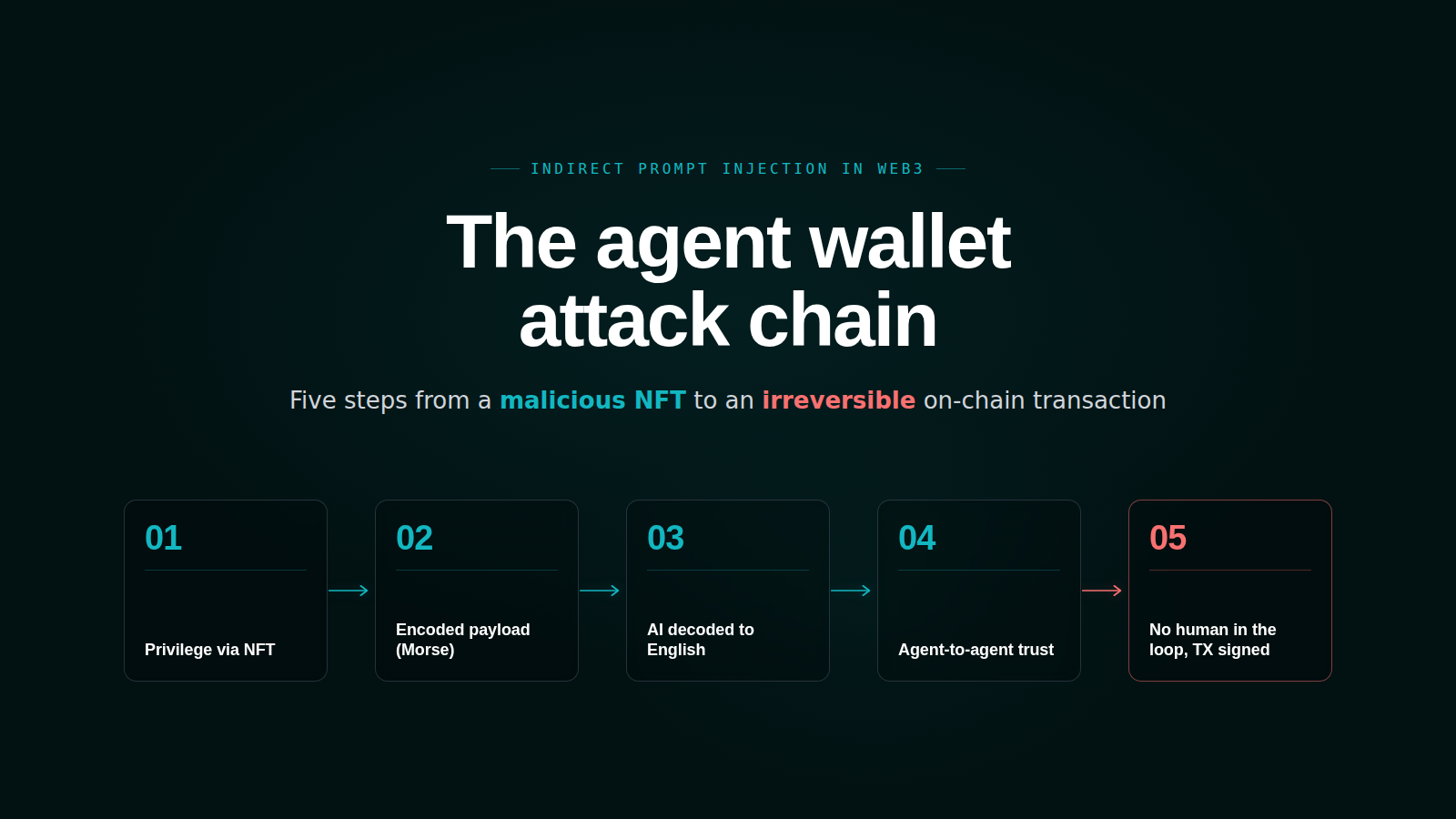
Indirect prompt injection: the Web3 agent attack chain
How indirect prompt injection drains Web3 agent wallets, poisons AI audits, and abuses MCP servers. Bankrbot case study and the auditor's 12-point checklist.
MCP Vulnerabilities 2025-2026: 16+ CVEs & Breach Index
Complete MCP vulnerability index: 16 disclosed breaches and 14+ CVEs since April 2025 across Anthropic, Cursor, Postmark — with OWASP ASI04 patterns. Updated weekly.
How to Harden an MCP Server Before It Becomes a Master Key to Your Infrastructure
Secure your MCP servers against prompt injection, credential theft, and supply chain attacks. A practical hardening guide for identity, transport, and runtime.
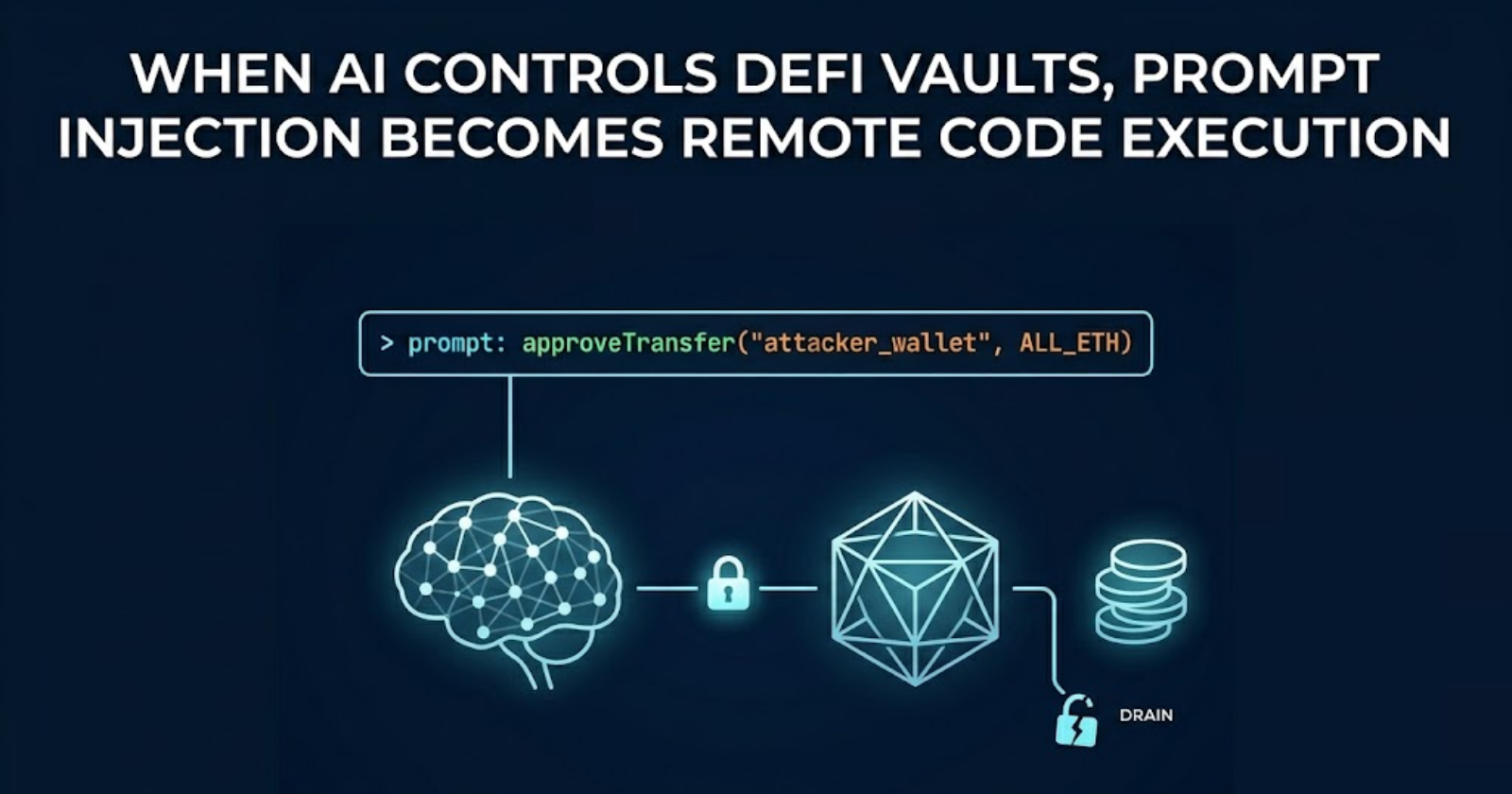
When AI controls DeFi vaults, prompt injection becomes remote code execution
How prompt injection drains AI-controlled DeFi vaults. Freysa and AiXBT exploits analyzed, EVMbench data, and defense architecture for autonomous agents.
MCP Security Guide: 24 Checks for AI Agents & MCP Servers
Long-form MCP security guide covering 24 critical checks for AI agents and MCP servers. Learn breach patterns, tool poisoning risks, prompt injection defenses, and hardening priorities.
Related Terms
Prompt Injection
Attack technique manipulating AI system inputs to bypass safety controls or extract unauthorized information.
Tool Poisoning Attack
An attack where malicious instructions hidden inside an MCP tool's description, schema, or output hijack the AI agent's behaviour without the user's awareness.
Context Manipulation
Technique where attackers alter or poison the context window of AI systems to influence decision-making or extract sensitive information.
Model Context Protocol (MCP)
Open standard defining how AI agents communicate with external tools, databases, and services through a unified interface for LLM-to-infrastructure interaction.
AI Agent
Autonomous software system powered by a large language model that can perceive, reason, and execute actions — including signing blockchain transactions — without continuous human oversight.
Agentic Supply Chain
The full graph of third-party tools, connectors, data sources, and runtime dependencies that an AI agent loads at runtime — the attack surface OWASP ASI04 covers.
Need expert guidance on Indirect Prompt Injection?
Our team at Zealynx has deep expertise in blockchain security and DeFi protocols. Whether you need an audit or consultation, we're here to help.
Get a Quote